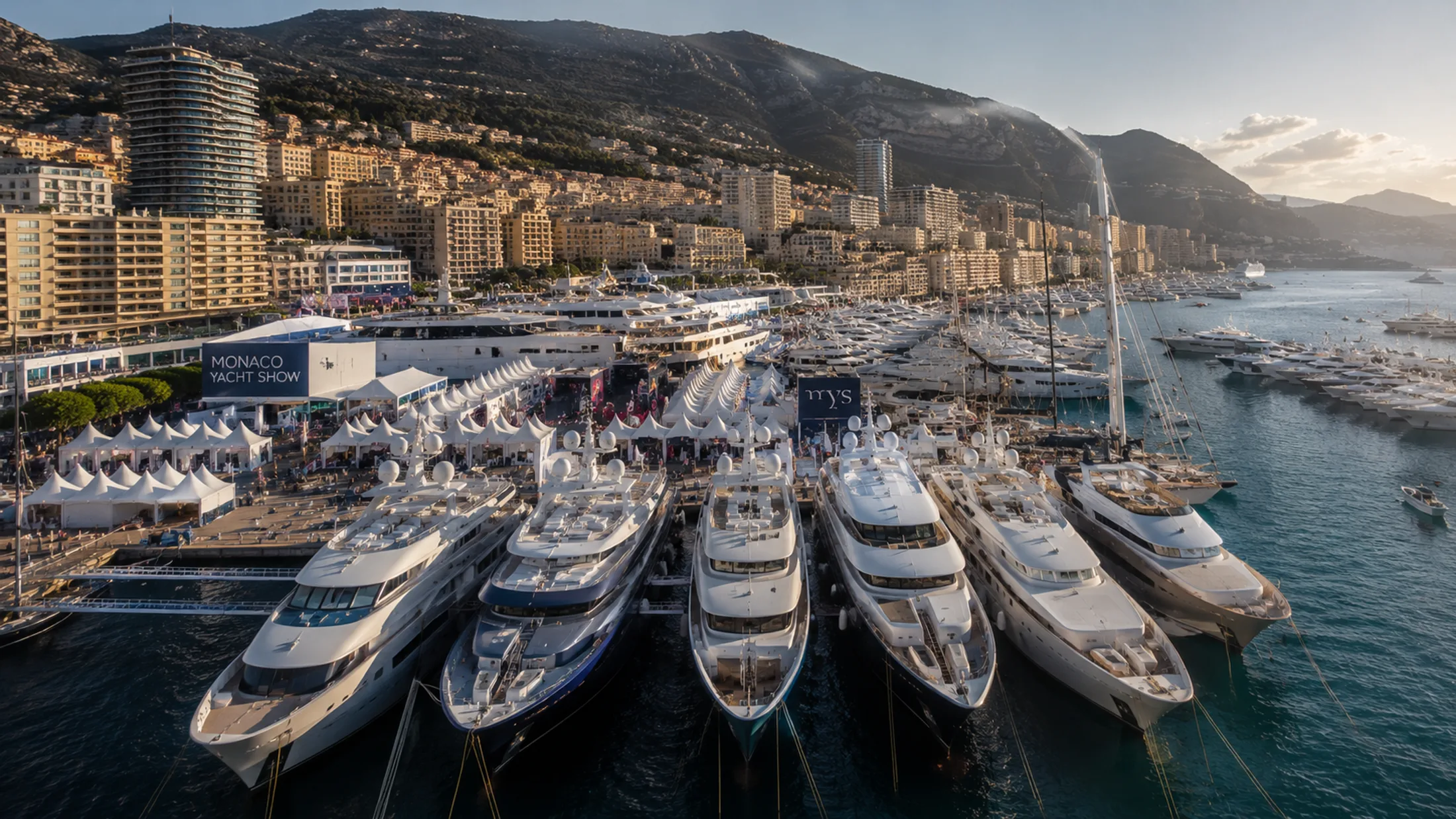
By the last week of September the harbour has been quietly emptied of its own boats. The owners who keep a berth in Port Hercule the rest of the year are asked, politely and a long way in advance, to move on; in their place arrives a fleet that does not so much moor as occupy. For four days at the end of the month, Monaco’s only deep-water port becomes a wall of superyachts — bow to stern, rafted two and three deep along the quays — and the principality rearranges itself around them.
This is the Monaco Yacht Show, the largest gathering of its kind anywhere, and it does not pretend otherwise. More than a hundred superyachts come for it, many of them shown for the first time, the longest running well past ninety metres. From the terraces above the port they read as a single improbable object: a temporary city of white hulls and dark glass, lit at night like a small financial district that happens to float.
You can buy a ticket and walk the quays, and a great many people do. But to read the week correctly you have to understand that the yachts are not really the event. They are the showroom. The event is the conversation taking place a deck above your head.
A harbour, and an idea, from 1991
The show began in 1991, modestly by the standards it now sets, and grew into the fixed point of the superyacht calendar. The logic was always geographic. Monaco is the industry’s spiritual address — a sovereign two square kilometres with a deep-water port, a tax temperament that suits the clientele, and a ruling family with the sea in its history. Put the world’s most expensive moveable assets in that harbour for four days and the people who build, broker, design and own them will arrange their year around being there.
What they come to see are the débuts. The great northern European yards — the names spoken with reverence in this world — choose Monaco to reveal their newest launches, hulls that have spent years in build sheds in Germany or the Netherlands and are seen in public, fully dressed, for the first time. Around them gather hundreds of exhibitors: the designers and naval architects, the makers of tenders and submersibles and the absurd, marvellous “toys,” the supercar marques that line a dedicated quay, and in recent years a growing cluster devoted to cleaner propulsion and the industry’s uneasy conversation with its own footprint.
It sits, too, within Monaco’s own institutions. The Yacht Club de Monaco — the great Norman Foster building on the opposite side of the port, opened in 2014 and presided over by Prince Albert II — keeps its own programme of dinners and prize-givings through the week. The show has a host, and the host is the principality itself.
What the week is actually for
Spend a morning on the quays and the choreography becomes legible. There is the public, paying handsomely for a day ticket and the right to look. There are the brokers, moving with purpose, lanyards turned discreetly inward. And there are the appointments — the private viewings, booked weeks ahead, where a prospective owner and a small retinue of advisers are walked through a hundred-metre yacht the way one is shown a house, except that the house costs more than most companies and the viewing is a negotiation conducted in the language of nobody-is-negotiating.
A meaningful share of the year’s brokerage moves through these four days. Yachts change hands, or begin to; new builds are commissioned over lunch; the family offices and the maritime lawyers and the wealth managers who orbit this money are all quietly present, doing the unglamorous work that turns a walk along a gangway into a contract. The spectacle is generous and entirely real. It is also, in the way of these things, a kind of cover for the business underneath it.
The yachts are the exhibition. The brokerage is the point.
Where Monaco changes
Monaco is small enough that a single event reshapes the whole of it. For the show, the principality bends toward the water. La Condamine, the ward that wraps the port, becomes the centre of gravity; the Quai Antoine 1er fills with pavilions; and the broad stretch of tarmac that in May is the Grand Prix’s harbourside straight now carries marquees and security and the slow current of people in good shoes. Helicopters cross overhead with a regularity that stops being remarkable by the second day.
Above it all sits Monte-Carlo, with the Casino and the grand hotels; across the port rises Le Rocher, the old town and the Prince’s Palace looking down on the spectacle as it has looked down on everything else. The geography does the staging. There are few cities where wealth is so concentrated and so vertical, and the show uses every metre of it.
Hotels, and the atmosphere they keep
The rooms go early and they go dear. The Hôtel de Paris and the Hermitage on the Place du Casino, the Hôtel Métropole a few steps away, the Fairmont astride its famous hairpin, the Monte-Carlo Bay out toward the Larvotto — for one week they stop being hotels and become the show’s drawing rooms. Terraces turn into meeting tables; the bar of the Hôtel de Paris keeps a particular kind of late-evening density. Reservations that are hard in an ordinary week become, during the show, a matter of who you know.
The atmosphere is a study in two kinds of money: the sort that announces itself, in watches and engine notes and a certain volume, and the sort that has nothing left to prove and therefore says very little. The second kind is the one that tends to own the largest yacht in the harbour, and the one you are least likely to notice.
Port Hercule, for four days
The port itself is the theatre. By the eve of opening the hulls are in place, rafted along the quays and the central pier, gangways down, passerelles polished, crews in matching polos arranged like a guard of honour at the foot of each. Tenders cut back and forth across the basin, ferrying guests from the yachts moored too far out to walk to. The whole harbour acquires a low, expensive hum.
What you notice, walking it, is the difference between the two crowds the port holds at once. There is the river of the curious, moving along the public route, phones up, reading the names on the sterns. And there is the quieter traffic of the expected — the people met at the foot of a gangway by name, walked up and out of sight. The port shows you the surface and keeps the substance one deck higher, which is, when you think about it, the whole proposition of the place.
Who comes
The guest list is narrower than the ticket sales suggest. Owners and the soon-to-be; the brokers and the broker’s brokers; the executives of the shipyards, in from the north for their one great selling week of the year; the designers whose work is the reason a hull is beautiful as well as enormous; the advisers, legal and financial and discreet to a fault; the maritime press; and, threaded through all of it, the simply curious who paid to see how the other tenth of one per cent spends a Tuesday.
It is a small world performing for itself, and like all such worlds it runs on a code most visitors never quite crack: who is buying and who is only looking, who is being courted and who is being politely managed, which conversations on which afterdeck actually matter. Everyone reads it. Almost no one says so.
Arrival, in Monaco, is part of the performance — and during the show it is also the week’s real logistical problem. The principality has no airport of its own; everyone comes through Nice, thirty kilometres west along the coast, and how you cover those last kilometres says a good deal about your week.
After the gangways come down
By Sunday it is over. The fleet slips its lines and disperses — to the Caribbean, to refit yards, to the next show on the next coast — and within a day or two Port Hercule has refilled with its own residents, as though the giants had never been. Monaco folds back to its compact, vertical routine; the marquees come down off the harbourside straight; the helicopters thin out.
What is left is harder to photograph than a hundred-metre hull at dusk. For four days the smallest country on the Mediterranean turns its only harbour into the trading floor of an entire industry, and the world’s most serious yacht money comes to do its business in plain sight and out of earshot at once. The fleet was the spectacle. The week was about everything decided quietly above it — which is, in the end, the most Monaco thing of all.