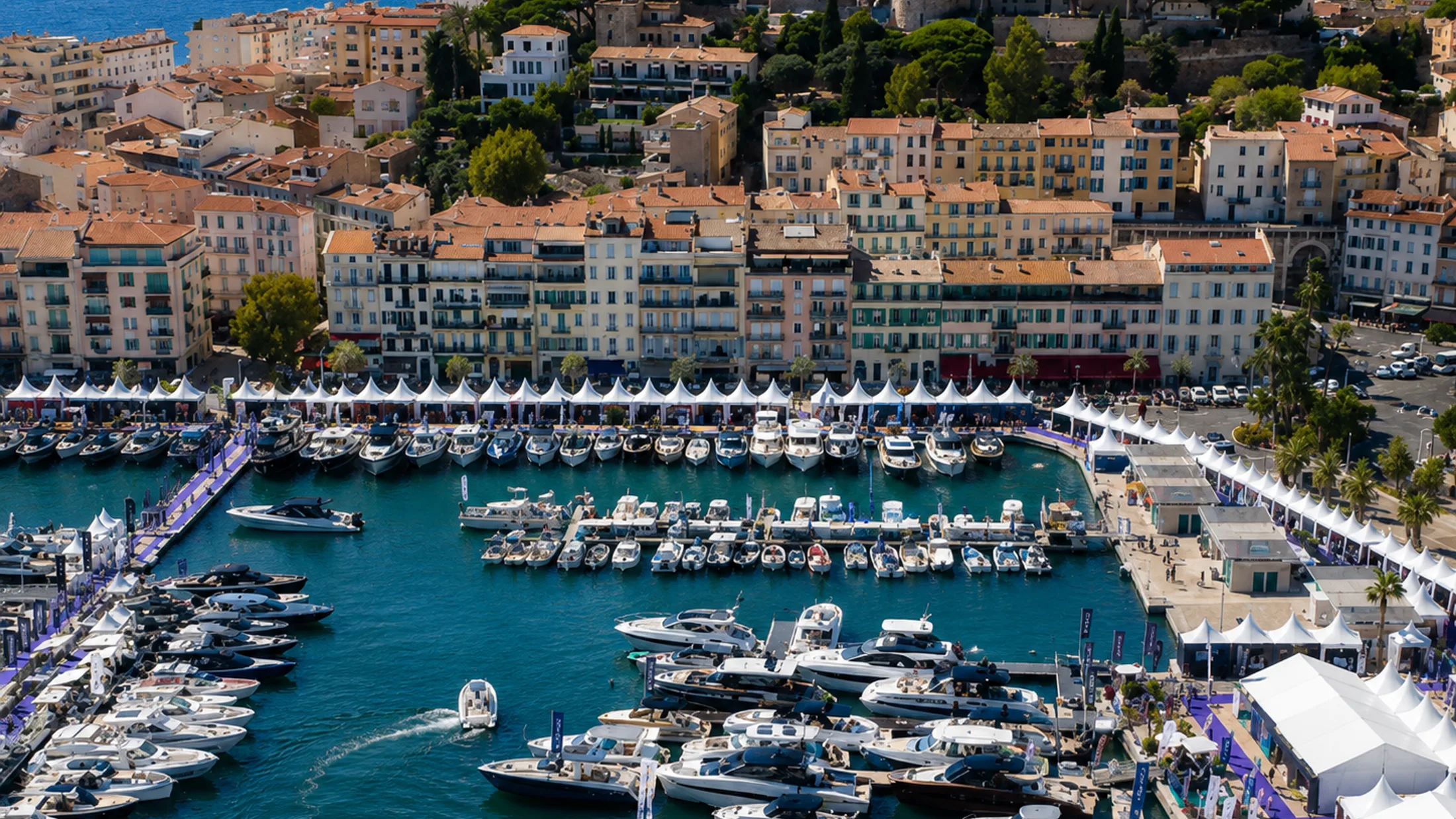
The boats arrive before the crowds. For a week or so at the end of summer, Cannes gives its harbours over to a slow, deliberate ballet of arrivals — hulls eased stern-to along the quays of the Vieux Port, masts stepped and rigged at Port Canto, crews working in the early light before the gates open and the public arrives to look. By the time the first visitors walk the pontoons, the water has already been rearranged into something it is not the rest of the year: a floating showroom for the whole of the coming season.
This is the Cannes Yachting Festival, and it has a particular place in the calendar. It is the first of the great European in-water shows, the one that opens the autumn season before the fleets move on to Monaco, Genoa and Southampton. What happens on these pontoons in September sets the tone — and a good deal of the order book — for the months that follow.
The Boats Arrive Before the Crowds
An in-water show is a different animal from a hall full of stands. Here the boats sit in their element, afloat and boarded, and a visit is less a walk past exhibits than a morning spent stepping on and off them. Several hundred craft fill the two harbours — day boats and tenders, sailing yachts, motor yachts and, at the upper end, units large enough to draw a crowd on their own. Many are world or European premières, shown on the water for the first time.
That breadth is the point. Cannes is one of the few shows that runs the full length of the market in a single setting, from a modest weekend boat to something with a professional crew — which is exactly why the trade treats the opening days as seriously as the public treats the weekend.
Why Cannes Matters in the Yachting World
Timing and geography did most of the work. Cannes opens the season, so the new models the yards have spent a year preparing tend to break cover here first; a strong Cannes is read, rightly or not, as a sign for the autumn. And the setting is unimprovable — a deep-water bay, a working old port in the centre of a town built for exactly this kind of arrival, and a coastline that has been the industry’s natural habitat for the better part of a century.
It also sits in conversation with the rest of the Riviera’s calendar. A fortnight or so later the same clientele reconvenes along the coast for the Monaco Yacht Show, the superyacht apex. Cannes is the broader, more democratic opening act; Monaco is the rarefied finale. Together they bracket the month the yachting world spends on this stretch of water.
Vieux Port and Port Canto
The festival is not one show but two harbours, a short distance apart at either end of the bay. The Vieux Port is the historic heart of it, set right beside the Palais des Festivals in the middle of town, its quays given over to the motor fleet and the larger units, the masts and superstructures rising directly against the old façades and the hill of Le Suquet behind.
Port Canto, at the eastern end of the Croisette, is the quieter, greener counterpart — the home of the sailing fleet and a calmer, more considered register, shaded by umbrella pines. A shuttle links the two, but many visitors simply walk the Croisette between them, which is no hardship in September. The two-harbour layout is part of the experience: you read the show as a journey along the front rather than a single enclosure.
Who Actually Attends
The crowd is a careful mix. There are the buyers — established owners trading up, first-time buyers circling a particular model for a year. There are the brokers and the dealers, the shipyard teams in from across Europe, the designers and the equipment makers, the charter companies and the financiers and insurers who quietly underwrite the whole business. And there is the public, who pay for a ticket and the pleasure of stepping aboard boats most will admire rather than buy.
What distinguishes Cannes from a purely trade event is that these audiences share the same pontoons. The serious negotiation and the Saturday daydream happen a few metres apart, and the show is built to hold both without embarrassment.
The boats are the spectacle. The season’s business begins here.
The Business Behind the Lifestyle
Beneath the obvious glamour, Cannes is a working market. Orders are placed and deposits taken; build slots for the year ahead are negotiated on board; the brokerage and charter trade does a meaningful share of its annual business in these few days. The lifestyle imagery — the teak, the linen, the light on the water — is real enough, but it sits on top of an industry doing serious commercial work to a tight seasonal rhythm.
That is the quiet thesis of the week, and the thing a first-time visitor often misses. The boats are the spectacle. The handshakes on the afterdecks are the point.
The Atmosphere in September
September is the kindest month to see Cannes. The fierce heat of August has softened, the light has turned long and gold, and the town has exhaled its peak-summer holiday crowds without yet emptying out. Into that calmer city the festival brings a particular energy — purposeful rather than frantic, more linen jacket than lanyard — and the front takes on the agreeable hum of people who are pleased to be exactly where they are.
It is, in its way, the most relaxed of the Riviera’s great gatherings. The business is real, but the setting refuses to let anyone forget that this is still, fundamentally, a town by the sea at the loveliest time of its year.
Hotels, Restaurants and the City
The grand hotels of the Croisette — the Carlton, the Martinez, the Majestic among them — sit within walking distance of both harbours, which during the festival makes them the natural base for anyone here to work. Their terraces become meeting rooms by day and tables by night; rooms tighten well in advance, though the September squeeze is gentler than the one the film and advertising festivals impose in spring and early summer.
Away from the front, the city does what Cannes does best: the restaurants of the Vieux Port, the climb up into Le Suquet for a view back over the masts, the markets and the side streets that carry on regardless of who is in town. The festival is the reason to come, but the city is what makes the trip worth extending by a day.
Practical Notes
The festival runs across several days in September, split between the two harbours, with the Vieux Port at the centre of town and Port Canto a stroll east along the Croisette. Tickets are sold to the public; the early days skew to the trade. As with everything in Cannes, the logistics are less about the short distances than about timing your arrival into a town that fills quickly.
Conclusion
Every season needs a starting gun, and on the water it is fired in Cannes. For a few September days the town turns its harbours into a single long exhibition, the year’s new boats arrive before anyone is watching, and an industry quietly settles the shape of its autumn between the pontoons. The spectacle is generous and the setting is faultless — but the festival’s real significance is that it goes first. What Cannes shows in September, the rest of the season spends the next nine months answering.