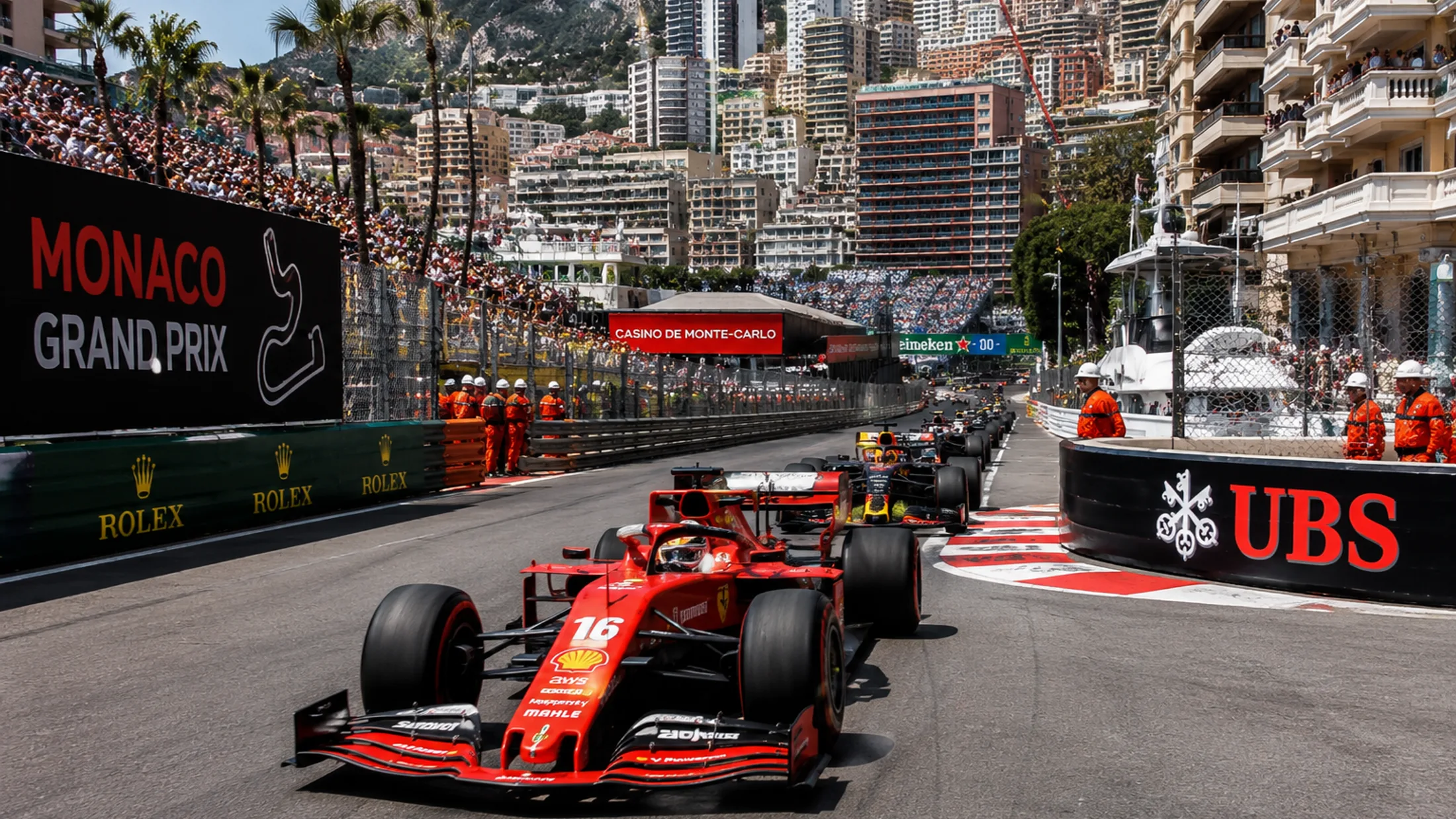
For one weekend each May, Monaco stops being a city and becomes a circuit. The barriers and grandstands go up weeks in advance; the harbour fills with yachts moored flank to flank; and the same streets that carry the principality’s ordinary traffic the rest of the year are handed over to the fastest cars in the world, threading between the steel barriers at speeds the geography seems expressly designed to forbid. The Monaco Grand Prix is the most famous race in motorsport and, by any rational measure, the least sensible. The contradiction is the entire point.
Nowhere else does Formula 1 run through a living city — past the Casino, down to the harbour, into a tunnel and out again into the Mediterranean light. The cars have long outgrown the streets that made the race’s name. And yet a win here still outranks almost any other on a driver’s record, and the principality still arranges its whole year around the last weekend of May.
A Race Through the Streets
The Grand Prix was first run in 1929, the idea of Antony Noghès under the patronage of Prince Louis II, and it has been organised ever since by the Automobile Club de Monaco. It joined the Formula 1 World Championship at the championship’s beginning and has stayed at its symbolic centre ever since — one leg of motorsport’s unofficial Triple Crown, alongside the Indianapolis 500 and the Le Mans 24 Hours, and the one most drivers say they would choose if they could win only one.
What it has never been is logical. The track is too tight, the cars too large, the margins too small. But Monaco trades on prestige rather than practicality, and the race endures precisely because it refuses to modernise away the thing that makes it itself: a Grand Prix run, improbably, through the streets of a sovereign town.
The Circuit Itself
A lap of Monaco is a tour of the principality’s geography. The cars launch up from the start past Sainte-Dévote and climb the hill toward Casino Square, sweeping past the Hôtel de Paris before plunging down through Mirabeau to the Fairmont Hairpin — the slowest corner in Formula 1, taken at little more than walking pace, hemmed in on every side. Then Portier, and the tunnel: the only one on the calendar, a blind rush from shadow into the glare off the harbour. Out the far side comes the chicane, Tabac, the swimming-pool section threaded between the barriers, and finally La Rascasse, named for the bar on the corner, before the lap begins again.
It is the slowest and tightest circuit of the season, and the one where overtaking is famously close to impossible. That single fact reshapes the whole weekend: at Monaco it is Saturday’s qualifying, not Sunday’s race, that tends to decide the outcome. Position is everything when the track gives almost nothing away.
What the Weekend Is Actually Like
To stand near the circuit is to understand the race with your whole body. The sound has nowhere to go — it ricochets off the façades, concentrates in the tunnel, and arrives as something closer to pressure than noise. The cars pass close enough to feel, and the proximity that television flattens is, in person, the whole experience.
Away from the barriers, the weekend runs at two speeds. There is the sport — the sessions building toward qualifying and the race — and there is everything arranged around it: the terraces, the lunches that stretch into afternoons, the slow social choreography of a town that has invited the world and intends to be seen hosting it well.
The cars have outgrown the streets. Monaco was never really about the racing.
Where the City Changes
Grandstands rise along the harbour front and around the Casino; sections of the principality that are public thoroughfares all year become ticketed, fenced and patrolled. The apartments and terraces overlooking the circuit are let for the weekend at prices that rival a hotel suite, their balconies turned into private viewing boxes. And the harbour — Port Hercule, the same water that hosts the Yacht Show in September — fills with superyachts moored stern-to, their afterdecks the most coveted seats in the sport.
For three days the geography that makes Monaco feel like a stage set is pressed into exactly that role. The race is the reason; the spectacle of the principality performing itself is the rest of the show.
Who Comes
The guest list is the most concentrated in motorsport. The Formula 1 paddock in full; the royal family, with Prince Albert II presenting the winner’s trophy as his forebears have done; the sponsors and the principals for whom Monaco is the season’s showcase; the celebrities the cameras seek out on the grid; and the yacht set, watching from the harbour with a glass in hand. Threaded through it all are the fans, who climb to the Rock or pack the public vantage points for a weekend that needs no introduction.
It is, in short, the race everyone wants to be at — which is rather the point of holding it here, in the one place built to make that wanting visible.
Why It Endures
By the logic of modern Formula 1, Monaco should not survive: the racing is hard to follow, harder still to win on merit alone, and impossible to reconcile with the size of the cars. It endures because it was never really about the racing. It is about prestige — the driver’s, the sponsor’s, the principality’s — and prestige is the one commodity Monaco has always known how to manufacture. The Grand Prix is the weekend the world looks at Monaco and Monaco looks entirely at ease being looked at.
Getting There
Race week turns Monaco’s own roads into the circuit, which makes arrival its own small art. Everyone comes through Nice, and the last stretch into the principality is the part that rewards planning.
Conclusion
When the barriers come down and the grandstands are unbolted, the streets revert to their ordinary purpose, the yachts cast off, and Monaco folds back into its vertical routine until the next May. For one weekend, though, the smallest place on the calendar holds the loudest event in the sport — a race that makes no sense and needs none, run through the front rooms of a principality that has spent a century learning exactly how to host it. The cars will always be too big for the streets. That is the reason to go.